Thursday, December 1, 2016

REMOTE IMPORTANT REGIONS


          At about 9:30pm on Tuesday November 8th, I was driving across the Golden Gate Bridge, listening to Leonard Cohen. Night had fallen in the USA. I risked danger, posting this video on Instagram from the car:


Everybody knows that the dice are loaded
Everybody rolls with their fingers crossed
Everybody knows the war is over
Everybody knows the good guys lost
Everybody knows the fight was fixed
The poor stay poor, the rich get rich
That's how it goes
Everybody knows

            This fact. This FACT. That we now know, that we wrestle with every day, was just starting to become true as I drove into San Francisco. It become more true as the night went on.  It became truer the next week, as Bannon happened, Sessions happened, more stormclouds continued to gather.  Every day the fact gets truer. 

            In attempting to process these first weeks of our new world, it has been hard for me to deal with facts.  It is hard to be on Facebook, to read news, to discover new things.  Facts activate my imagination: what might be in store for us?  And I know in one sense, to avoid these facts is weakness.  We must pay attention, now more than ever, we must know the facts, and continue to search for them.

But right now facts are hard to grasp in this time of profound uncertainty.  We just don’t know what the fuck is going to happen.  And I’m so deep in uncertainty, that other worlds less factual, of interpretation and ambivalence, like poetry, provide comfort and perspective.  Maybe because right now, in this transitional space, at the beginning of this one huge hard terrible fact, all I can do right now is interpret.

The day after the election, Linda the Zen Priestess who presided over our wedding ceremony sent a poem to my wife and me called “A Ritual to Read to Each Other” by William Stafford.  It starts like this:

If you don't know the kind of person I am
and I don't know the kind of person you are
a pattern that others made may prevail in the
world
and following the wrong god home, 
we may miss
our star.

            We followed the wrong god home.  It's a moment of national grief.  Though no one, thankfully, has died (I mean to say we cannot accuse Donald Trump directly of killing anyone). We are mourning the loss of Hillary as President.  Mourning everything she stood for, all of the tolerance, progress (and facts!) that Donald Trump and his advisors appear to turn away from. And the announcement of Leonard Cohen’s death the day after the election brought things home for me.  My mother loved Leonard Cohen, and she died this year in March.  And the times when I feel my mother’s absence the most are these times, when I know she’d be able to comfort us.  These times: when my wife and I have a question about our newborn daughter, when Leonard Cohen dies, when Donald Trump is elected president of the United States.  

            So (as John Oliver put it so well) FUCKING TWENTY SIXTEEN has culminated in this collision of griefs: national and personal.  I am asking myself what would she say?  How would she help us deal?

I remember about a year ago dancing to Leonard Cohen with my mom in her living room. We were listening to “That’s No Way to Say Goodbye,” and she was crying, thinking about having to leave my father and sister and me. I loved the way my mom danced.  There was something quite unmusical about it, something almost floppy, but then at the same time, she had rhythm, and most of all, personality: she was always free, never self-conscious.  She often did this move with her fists, pumping them forward and back coming out from her chest, like a jack-in-the-box. At that time, she was about two thirds of the way through her battle with lung cancer.

I know one thing that drew my mother to Leonard Cohen was his grace. She knew grace because she had it, a whole lot of it. And I hope Leonard Cohen was able to die as gracefully as my mother did.  In her last few months, she and her beloved friend Jan packed things up in her house, carefully, ceremonially.  She went over with my father, sister and me the numerous, finite details of what we should do after she died, how it would all go, how everything would fall into place.  She got everything ready. She sent us all her passwords in one email.

Those discussions were hard.  In one we were back in the living room.  I was watching the green numbers on her little black CD player as we talked. I implored her to stay in the moment, to enjoy her days with us and not talk about the future.  My resistance to her made her cry. And looking back on it now, I realize she was in the moment. She was in the moment of her dying, and in her role of being a champion caretaker.  She was making sure we would have a structure in her aftermath, and in her taking care of that (taking care of us), she was taking care of herself.  Her tearful reaction to my resistance was a response to the truth of the situation: my inability to empathize with her created distance between us.  She told me that. She asked me to be there with her, to acknowledge her reality.  But in those moments of all that planning, it was really hard. 

           Here's the end section of Stafford's poem that Linda the Priestess sent to us the morning after the election:

And so I appeal to a voice, to something shadowy,
a remote important region in all who talk:
though we could fool each other, we should consider--
lest the parade of our mutual life get lost in the dark.
For it is important that awake people be awake,
or a breaking line may discourage them back to sleep;
the signals we give-- yes or no, or maybe--
should be clear: the darkness around us is deep.

In Stafford’s lines, I can see my mother and I.  She cried because the “parade of our mutual life” was getting lost in the dark.  In the dark I thrust myself into by not being “awake” to her state of being.  My mother was never trying to fool anyone (implicit in her dancing).  In those moments of planning, her signals were clear: the darkness around her was deep.  A part of me was not awake to her darkness.  Was Donald Trump chosen because our nation is not awake to its darknesses?

My mother surely would have lamented this out about the election— all those people that Donald Trump fooled.  He is Stafford’s “breaking line” that discouraged people back to sleep.  As Saul Williams said the day after the election, “You have elected a caricatured mascot… a totem to your ignorance…here is the proof of the internal battles you have not fought.”  And might those internal battles dwell in that “remote important region” that Stafford speaks of?

             In our national grief, as we talk to each other, I watch friends rise to heights of eloquence in places that discourage it, like Facebook.  It is clear people are accessing those remote important regions.  We are summoned to do more, to act more, to speak, raise our voices (we better start swimming or we’ll sink like a stone).  But it makes me miss my mom.

When the results started getting hairy on that fateful Tuesday evening, and Hillary’s FiveThirtyEight percentages started to go down, my wife, sister, father and I had a quick text exchange.  I knew things were bad because that was the first time my Dad had ever texted.  We were all worried.  I texted everyone Keep the faith and take heart. Which is not something I would ever say.   Those were my mother’s words.  She said that a lot. Take heart Naftali.  What a phrase.  When my mother said it, it always felt good.  But I never thought about what it really meant.

The morning after the election, waking to shock, I thought about what it means to take heart. I've kept thinking about it.  And I arrived at the idea of actually holding a working human heart.  Taking it up in my hands, the physical reality of that. Of feeling it beating, blood running through my fingers, slimy, pulsing. It’s not so common, but let’s pretend for a moment this is happening and possible and that whoever’s heart it is you’re holding, they’re alive and everything’s fine.  Maybe you take up someone else’s, maybe you take up your own. Maybe I’m out in Michigan in Monroe County, looking at a white guy with a family who voted for Obama in 2012 and Trump in 2016.  I’m looking at him and I’m holding his heart in my hands. And he’s looking at me, wondering when I’ll put his heart back inside his body and let him get back to his family. I say to him I’m just here trying to figure out what my mom meant when she said take heart.  Thanks manAnd he says You’re welcome. I say I’m interested to hear why you voted for Trump. Not tonight he says.

Then I’m back in my house in California, looking in the mirror, holding my own heart.  My blood is dripping into the sink.  My wife is cooing to our daughter in the next room, waiting for me to change the diaper (has Donald Trump ever changed a diaper?).  What do I say to myself? What do I say to my mother? What do we say?

 I wish she could meet her granddaughter, wish she could see our house, wish she could laugh and cry and cry and laugh with us some more.  I wish she’d tell us what to do.  I think she’d say all you can do is keep living your lives with integrity and can you believe that pardon-my-French sick fucking chauvinist pig won? She'd send us some poetry. She might remind us there is a crack in everything.   She might take up our hearts in her hands-- carefully, gracefully-- and then give them back a little better than they were before.


CREDITS
I tried but couldn't figure out who took those pictures...
Where I got the Leonard Cohen Picture
Where I got the picture of people at the Javits Center on election night

Wednesday, November 13, 2013

MARKERS 11.13.13

My godfather Fred Borcherdt is a sculptor.  He did a series of metal and wood sculptures meant to be placed in various locations across the wilds of the Southwestern United States.  He called them Markers.  What follows is my attempt to create three markers, related/un-related, with words instead of metal and wood.

MARKER I
It’s been a year and about two weeks since Hurricane Sandy ransacked the Northeast, and I’ve been wanting to write about an experience I had after the Hurricane.  A few days after Sandy my then girlfriend and I (our apartments were unaffected by the storm) went to volunteer at the local YMCA in Brooklyn, housed in the huge Park Slope Armory that they had miraculously converted overnight into a shelter for evacuees of nursing homes in the Rockaways.  The place was overstocked with volunteers, lined with rows and rows of beds, and I was assigned to bed-patrol—tasked to walk up and down a certain line and make sure each patient/person had what they needed.  The people were sitting, bundled, bridled, sleeping, wide-eyed, all laid out on those light, creaky beds no one ever wants to be laid out on. They were all in a general state of perplexedness, which mirrored my own feeling, I realized then.  As it was after September 11th, the world was confusing after Sandy.  It was about ten at night, quiet and echoey in the old Armory.

After plodding back and forth through the rows a few times and having done nothing except escort one guy to the bathroom and put another man to sleep trying to talk to him, I happened up on Klara.  Klara was a black woman, who looked like she could have been anywhere between 60 and 80, with the kind of cerulean eyes you find in people with Creole blood in New Orleans.  Most of her upper front teeth were missing, like everyone she was a little perplexed, but she had a base cheeriness about her. 

I don’t remember the beginning of our conversation, but I think I was talking to her for maybe an hour, alternately standing and squatting, until it seemed natural for me to sit on the edge of her bed.  I remember thinking, wait, I just sat on her bed without even asking her.  Such are these moments after hurricanes.

Klara told me about her dog.  “Blue” was a black Lab.  She had Blue when she lived in her apartment in Red Hook, where she lived for most of her life until she went to the nursing home.  She and Blue would take the subway up to Central Park and sometimes they would spend the whole night there, sleeping on the grass, watching the sun rise together from a bench.  Klara didn’t have children or a husband to speak of: Blue was her best beast.

When Blue died, Klara wrapped him in garbage bags and took him down to the rocks on the Red Hook waterfront (long before those rocks were torn apart by the Sandy surges), put him in the water and sent him out to the ocean.

That first night, Klara and I two specs on a creaky refugee bed in the Armory, she told me Blue didn’t really die when he went out to the ocean.  For years, even after she went to the nursing home, when she was in a rough place she’d have dreams about Blue.  She’d dream they were walking again through Central Park, or that he was lying right there on her feet at the end of her bed. Just the weight of him made her wake up and know that things would be alright.

At some point, she’d stopped having dreams about Blue.  She missed him.  She said she hoped that tonight, she’d dream of him.  It was about one in the morning and I asked her if she was tired and wanted to go to bed, and her beautiful eyes widened for a split-second, and then she said, No not really.

Before I left I asked her if she wanted anything—and she said some mango yogurt, please because that was her favorite and they were only giving out the plain kind.

The next day I went into a used bookstore and found a big coffee table book, a Taschen collection of photographs called “1000 DOGS.”  It weighed about five pounds, and seemed a bit ridiculous, but I bought it for Klara.

I went back to the Armory with the book and a few packs of mango yogurt and Klara was there, sitting on her bed, staring off into the distance, exactly as I’d left her.  When I gave her the book she groaned and said, It’s so heavy!

I showed her the trifle of an inscription I had written in the front, which said something like “I hope this makes you have dreams about Blue,”  and we set about arranging ourselves so we could both look at the book without lying together on her bed.  Eventually we found something that worked, and for the next couple of hours, Klara flipped through all 1000 dogs.  When she turned a page, she’d fold the corner strongly, an almost exaggerated authoritative turn, like some teachers in kindergarten do when they’re reading a book to the whole class.  If she saw a dog she liked, she would say Oh! from her belly, with a certain energy.  Sometimes she’d smile.  

When we were finished, I helped Klara put the book down at the side of her bed, and told her I was sorry it was heavy and that she could get rid of it whenever she wanted.  That was the second night.

The third time I went back to see Klara, she told me about her collecting. One of her hobbies, besides walking with Blue, was going to art auctions.  Though she couldn’t afford to buy anything, she would stand in the back (because black people weren’t allowed at those auctions then) and watch.  Eventually the auctioneer noticed her, and invited her to stick around after everyone had left.  He told her he admired her, and started giving her left-over auction items.   I asked her what the man gave her and she couldn’t remember anything except for, strangely, a collection of handwritten letters of John F. Kennedy. 

Klara once had a collection of original handwritten letters of JFK.  And she collected a lot of things from auctions and elsewhere in her apartment until, as she put it, it all just got too much, and she gave it away to a man she had found in the classifieds, who bought the letters and everything else for something like a hundred dollars.

The next time I went back to see Klara, bearing more packs of yogurt, about half of the patients had been bussed off somewhere else, to another shelter, and Klara was among them.  I asked some of the nurses about her whereabouts, but they couldn’t give out that information.  I went to the food room for all the volunteers and left the yogurt in a pile of other food that needed to be kept cold.

MARKER II
Two weeks ago on Halloween, I was running my last run before the New York Marathon.  It was unseasonably warm, as it has been almost every Halloween that I’ve spent in New York City.  I was running along the edge of Prospect Park, on my way home, when I came upon a makeshift memorial at the entrance to the park, for a boy named Sammy.  A week before, Sammy had been killed when he chased a soccer ball onto Prospect Park West and was crushed by a van.  He was twelve years old.  I remembered that night seeing the ambulances, hearing the words hit a kid whispered as I ran by.  Then I had forgotten about it.

Now it was all laid out in a shrine of stuffed animals, flowers, newspaper headlines, notes from parents, class, friends, and strangers.  I stopped in the warm night to absorb it, and in the yellow light outside the park I was drawn to one particular note, taped with duct tape to the metal police barrier that formed the shrine’s skeleton.  It was from a girl named Miranda. From her handwriting, I guessed she was maybe six or seven.  At the bottom of the page, Miranda had sketched a boy beneath a rainbow, labeled the boy you and drawn a halo above the boy and marked that halo.   It was all pretty overwhelming, but the postscripts are what made me kneel for a while.  Over the rainbow, Miranda had written two:

P.S. This is a picture of where I hope you are.
P.P.S. The stones and rubber band bracelet are from me. They are in the orange cup made of paper.)


MARKER III
Two days after I stopped at Sammy's shrine, I was running in the Marathon, pacing a dear friend.  We’ve run it before.  We know the course.  We know the rough spots, and the places where the exuberant crowds take over for your aching lungs and legs.  Mostly you run those miles through Brooklyn and Manhattan and the Bronx, and there are lots and lots of signs.  You ignore them sometimes because most of them don’t say your name on it (especially if you have a name like mine) and you're just trying to run.  But this year in East Harlem, on a desolate stretch of mile 19, a beautiful young woman was holding up a sign in big black scrawl.  Her face was solemn as we passed her.  The sign read:


            I am proud of you, perfect stranger.


Sunday, February 5, 2012

FOOTBALL ACCOUNTING

In the last few months I’ve been telling a lot of people that baseball is my favorite sport, but football is the only sport that’s ever made me cry.  This has come up in conversations centered around what my friend David calls my “bandwagoneering” of the San Francisco 49ers.  It’s been a long time since I followed football, and for the second half of the 2011 NFL football season, I've been riveted by the Niners and football in general.

The last time I really paid attention to the 49ers was in 1999, when my father and I witnessed firsthand what’s come to be known as “The Catch II,” Steve Young’s dime to Terrell Owens with 8 seconds left in the game to give the Niners a playoff win over the Green Bay Packers.  I was a freshman in college hugging my father, weeping at everything marvelous in the world as the crowd exploded around us. That was the second time I cried watching sports.  Then the Niners lost the division to the Falcons, and between then and this fall, I’d watched about three football games.

Since I began watching the Niners again this season, my friend David, whose brain and life is a sports almanac, has taken to incessantly pestering me to name 6 players on the Niners off the top of my head-- last week he did it and truth be told, I had a hard time.  I should be able to name 6 players in a heartbeat, given the energy and passion I direct toward a Sunday television screen when the 49ers are battling their brains out.  But since my love affair with NFL football was rekindled somewhere between Halloween and Thanksgiving, what I’ve been basking in mostly is just the great sum of all its parts: the new look of football, how it’s been high def’ed,  crystallined, and cinematized since the days of my youth, and also, something familiar, the sound of the crowd. It’s the anti-thesis of the baseball crowd. Not calm, not slow, barely a crescendo, a nearly constant roaring sea.
           
When I was growing up, Sundays were the worst.  Maybe it was just the shadows looming because I had to go back to school the next day, but somehow Sundays were the day when my parents fought, the day that I fucked up the worst, the day I had to slog through all the homework I hadn’t done, the day my mom just made quesadillas.  But for a few months each sunday in the fall and winter, whatever beef my dad and I were having and whatever else would be drowned for a few hours in that roaring sea.  And if you grew up in the Bay Area then, it wasn’t just any sea.  We were a father and son amidst Bill Walsh’s 49ers, possibly the greatest football teams of all time.  And that meant of course, that on some fifteen Sundays a year, I had Joe Montana to look forward to.


Which is why the first time I ever cried while watching a sports game was in 1990.  The New York Giants were playing the 49ers for the NFC Championship, just as they did two weeks ago today.  The 49ers were up by 4, deep in their own territory, and Leonard Marshall, enormous Leonard Marshall, on 3rd and long, laid a jackhammer of a sack on Joe Montana.  Joe Montana, for a while afterwards on the field on his hands and knees.  Joe. Down.


You can watch it here, and if you listen there’s something missing: you can’t hear that sea.  But that isn’t because games were quieter back then, it’s because the 49ers were playing at home, in Candlestick Park, and in those moments before and after, the people were becoming aware that the 80’s were over.   Leonard Marshall had just about laid Joe to rest.  Montana missed almost all of the next two seasons, then left the Niners for the Kansas City Chiefs.

I was ten years old after that game ended, and I cried like an animal in my dad’s study, in front of our little RCA color television, feeling a Leonard Marshall jackhammer- sized Sunday existential emptiness.  This was the first time I cried for a sport.  And such was my sadness after the game that my mother gave my father permission to buy me real candy.  My dad and I rode our bikes to the candy store downtown, and he bought me my favorite buttered popcorn and watermelon Jelly Bellies.  It got dark while we were out, and we had to walk our bikes up the big steep hill to my house.

One of the football games I did watch in the last decade was the 2008 Super Bowl between the New York Giants and the New England Patriots.  In this game, one of the biggest upsets of all time, Giants quarterback Eli Manning executed what my friends and I call the “double somehow.” Down by 4 points with a minute and ten seconds to go, on 3rd and 5, Eli Manning somehow broke out of a clawing cluster of Patriot pass- rushers to air an arching pass to David Tyree, which Tyree somehow caught for the first down that would set up Plaxico Burress’ game- winning touchdown.  That game and the double somehow instantly made me into a Giants fan.  So this season, when I haven’t been rooting for the 49ers, I’ve been rooting for the Giants.  And today, when the Giants go up against the Patriots in the Super Bowl, I’ll be screaming for the G-Men.

That friend of mine David is a Giants fan, and yesterday he joked that I can probably name more players on the Giants than I can the 49ers.  It might be true, but only because my friend Fernando’s last name is Cruz.  And a defensive end named Jason Pierre- Paul?  That's just unforgettable. And because usually it’s that skinny Jewish kid with glasses in 4th grade in the corner fiddling with a TI-82 whose name is Eli, not the Christian team captain. Somehow I’m rooting for the Giants.  Even though Leonard Marshall made me cry.

When we sit with our people, buffalo-wing-greased-fingers clasped tight, watching the helmets crash above the line in the middle of that roaring sea, we are witnessing a kind of war, and how the warriors suffer.  But they take the field of their own free will, as the broadcasters repeat over and over again so astutely, “they go out there every day and leave it all on the field.”  We make them our heroes, sometimes grow to love our mortal enemies, and we learn to cry. I’ll admit statistically, David, that I’m a bandwagoneer.  But I’m also just like everybody else, hoping for a miracle in the long Sunday shadows.

Wednesday, August 18, 2010

The Bell


And at last he reached the bell.  The bell with the iron or steel or some metal frame made from an old ship.  The bell with a strong double cord hanging from its clapper.  And when he pulled very lightly on the cord, so as not to ring the bell, but just to see what it felt like, what the weight was like of the cord in his hand, he heard the sound the clapper made when it was just activated ever so slightly, just swinging a bit up there on its own, for once independent of the bell.  And that sound it made it sounded to him like the violins from Bernard Herrmann's score to Psycho turned down very quietly (not just any violins but those and those only).  And he stood here tugging lightly on the strong cord listening to those two sounds, the only two sounds there were---the desert wind with the violins, just about to explode.

Tuesday, August 17, 2010

The Caves


LOOKING OUT AT SIERRA DEL SAN FRANCISCO
FROM EL PALMARITO CAVE


EL PALMARITO CAVE
SIERRA DEL SAN FRANCISCO

Sunday, August 15, 2010

La Sierra


UN VAQUERO
SIERRA DE SAN FRANCISCO MOUNTAIN RANGE

Saturday, August 14, 2010

El Panteón de San Ignacio


TWO FROM THE SAN IGNACIO CEMETERY


Friday, August 13, 2010

In San Ignacio Pueblo


 CLEMENTE ARCE VILLAVICENCIO
ARTIST
SAN IGNACIO PUEBLO


I am now in the desert oasis pueblo of San Ignacio.  It's very different from the Lagoon.  At the Lagoon, everything is open, you can see for miles and miles and miles.  Here in the town of San Ignacio, it's exactly the opposite.  We are in a valley, a river runs through it, and everywhere you look there are trees and roofs and things to cover you.  Even the horizons are covered in every direction by mesas which overlook the town, and hovering above them the ever present vultures.

Thursday, August 12, 2010

Before you leave the lagoon


JUAN MARIA AGUILAR

LAGUNA SAN IGNACIO

Before you leave the lagoon, visit the old man at the entrance who they call Shema.  He wears a knife on his belt, has a sign in his front yard that says "Wilkommen," and a dog named Diamond...

Wednesday, August 11, 2010

STINGS

I am sorry I am deliquent in posting my daily pictures.  Internet problems, and I've been stung by a stingray.  First, here are the pictures.


ANA RAQUEL FRANCO   YARENY MONTOYA   ARECELI MONTOYA
EL CARDÓN   LAGUNA SAN IGNACIO


LEONARDO RAMIREZ MORALES    SOFIA HIALI RAMIREZ MORALES
LA ESCUELITA    LAGUNA SAN IGNACIO


GERARDO "JERRY" FREER AND FRIEND
LA FREIDERA   LAGUNA SAN IGNACIO


A FEW EASY STEPS TO TREAT YOUR FOOT AFTER YOU HAVE BEEN STUNG BY A STINGRAY IN MEXICO WITHOUT DOCTORS OR NURSES, IF YOU ARE FORTUNATE TO BE ONLY BLEEDING AND NOT EXPERIENCING CHILLS, VOMITING, SUDDEN FAINTNESS, OR HAVING LOTS OF TROUBLE BREATHING (THEN YOU SHOULD GO TO THE EMERGENCY ROOM)

1a)   Know that if you have been walking (rather than shuffling, which is what you are supposed to do, Jerry calls it the "Stingray Shuffle") through shallow warm waters you have almost definitely been stung by a stingray, though it may have felt like a shark just bit you very hard and though you may be bleeding profusely.  If you weren't in so much pain and wondering who to go to, if it's major or minor or whether you will ever walk or run again, you would see that the actual cut bleeding place where the barbed stinger went in is very small and could definitely not be a shark bite.

1b) Tell someone or you yourself heat up enough boiling hot water to fill a bucket or tub that will cover your cut and foot.  It is important to do this now, as opposed to later.  I will tell you why in twenty minutes.

2) Run or squeeze or have someone else squeeze as much blood out of the sting as possible, as soon as possible, until it seems like there is no blood left.  Though this may hurt and feel a bit contrary to the task at hand, it is GOOD if you are bleeding, because the blood is getting venom out, and you must capitalize by squeeze squeeze squeezing that blood out because the venom can rocket throughout your whole body and go to your head and elsewhere, and you need to get as much of the stingray's venom out as possible.  The venom won't mess you up if you squeeze that shiznit out!
 
 3a) Heat some limes/ roast some limes close to an open flame, when they are very hot, cut them, and for twenty minutes or so squeeze a bit of lime juice over the cut, and then rub the cut with the piping hot lime until the lime is not so hot anymore.  This disinfects, continues to suck out venom, and actually feels good mostly.

3b) While the lime action is happening, take the water off the heater/boiler, put it in the bucket and let it start to cool.

4)  After you're done with your limes, your foot is probably still going to hurt like hell, you may have cried, you may have not cried, you may have almost cried just because the sight of another young man, a fisherman named Octaviano, heating limes and rubbing them confidently on your foot combined with the sound of another young man, Jerry an ex- bullfighter, saying things like "That's what killed Steve Irwin, man," is just too overwhelmingly everything for words.  Any which way you slice it, it's all good.  You are probably going to be nearly pain free in about an hour or so.  What you need to do now is put your foot into that hot water.  And here is the thing, you need to put your foot in water that is as hot as you can possibly stand, which is why at the beginning I said to start heating it, because hopefully by now it's cooled enough so you can put your foot in it.  Now of course you don't want to give your foot a third degree burn, but the hotter the water is, the better it is going to feel I am telling you.

5) Keep your foot in that water for about 45 minutes or so and witness a sudden change in life pain weather you never thought possible.  Here is why...

"Because stingray venoms are composed of heat-labile proteins, doing this will alter the tertiary structure of the polypetide protein molecule by denaturing and thereby deactivating the poison. "

-from WikiHow, How To Treat A Stingray Sting, Multiple Authors

Damn.  In the States I'd say that is pretty fucking cool.  In Baja, CHINGADERA.  You will most likely be nearly pain free after you take your foot out of that water.  BOOM.

Sunday, August 8, 2010

FRYING PAN


MARIA LUISA CAMACHO SALINAS
LA MAESTRA DE LA FREIDERA

Everyone calls her "Jacqui," because that was her grandmother's name.  No one thus far has been more instrumental in my explorations of Laguna San Ignacio than this woman.  She is the matron presiding over the whale camp where I've been staying for the last week.  This area of the lagoon is called La Freidera, which means "frying pan."  One hundred years ago when they were harvesting whales from the lagoon by the hundreds, this small beach was where they had the big machines they used to fry the whales and extract their blubber.

Saturday, August 7, 2010

The Full Gamut in San Ignacio


CEMETERY DE LA LAGUNA


FRIDAY NIGHT AT THE LAGOON


If you look back there on the upper left hand side of the picture of the cemetery, there's the edge of a black building.  That's one of the two very small chapels built in the name of one of the lagoon's deceased.  That particular one honors a young 15 year old boy who died of leukemia after a doctor misdiagnosed his throat problem and gave him four unsuccessful doses of anti-biotics.  His "casita" has a wooden door that swings open and closed with the wind.  I opened the door yesterday to find a small diamond- back rattlesnake just inside, stretched against the wall, its tongue flitting away. I returned today to the cemetery at midday, opened the door, and there the snake was, in the exact same place, curled up sleeping.


Friday, August 6, 2010

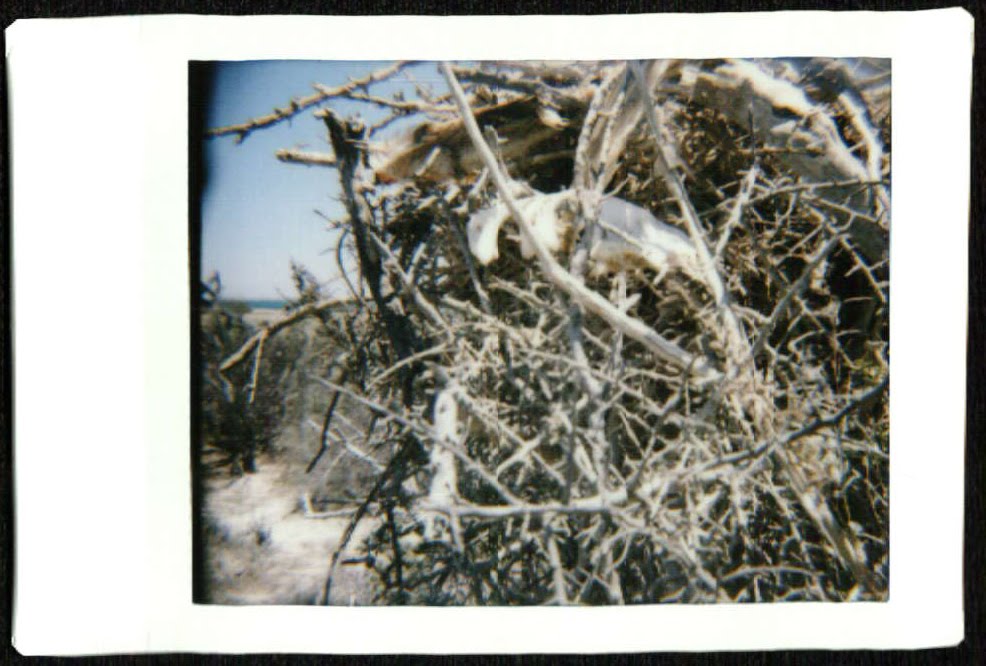
Nests


OSPREY NEST   LA ISLA GARZA
LAGUNA SAN IGNACIO


MIRIAM, JONI, ISAEL    LA BASE
LAGUNA SAN IGNACIO

Wednesday, August 4, 2010

Meeting Las Abuelitas


DONYA SILVIA, HER DAUGHTER ARLENE, AND ARLENE'S SON DIEGO
 EL CARDÓN    LAGUNA SAN IGNACIO

Today I walked around with my wonderful guide Jackie, talking to all different kinds of Grandmothers (and daughters and grandchildren).  We visited two out of three of the little outposts where people live on the lagoon, El Cardón (loosely, "thistle"), and Escuelita ("little school," where they have the elementary school and kindergarten). 

The first grandmother, Donya Maria, was about seventy.  Her boyfriend is 37.  She has 27 grandchildren by nine children and if her tenth child hadn't died it would probably be more.  Another grandmother, Donya Olivia, used to see lots of ghosts about twenty or thirty years ago, but she doesn't see them anymore and she doesn't know why. 

Tuesday, August 3, 2010

On my first day in San Ignacio Lagoon


BEGINNING TO PREPARE THE GUITAR FISH CATCH 
TO SHIP TO THE MARKET


RESTING IN THE MIDDLE

Monday, August 2, 2010

Having traveled upward through Mexico, northwest to San Ignacio


14:36 ON HIGHWAY ONE         SEA OF CORTEZ


GREY WHALE      ENTRANCE TO SAN IGNACIO


I've got to give a pound of respect to my serious black attitude. Yes that's right. My black Dodge Attitude that nobly and unfailingly negotiated 45 kilometers of a dirt, salt, clay, rock, shell, sand riveted road today and successfully landed me in five shifts of an American gear in San Ignacio Lagoon, a place I have been writing about for days and days, and have just now seen for the first time.


Sunday, August 1, 2010

Saturday, July 31, 2010

Day 2, Still in Loreto


     GRAVE SLAB, LORETO CEMETERY    LORETO,  MEXICO     


Friday, July 30, 2010

My First Day in Mexico


JOSE EMILIO TAYLOR COTA    LORETO, MEXICO


I'm traveling through Baja California doing the final on site research for the narrative feature I am writing, about a journalist who travels to San Ignacio Lagoon to write about the whales there.  I'm taking pictures with a Diana 120mm camera with an Insta-Back, which enables me to take mini-polaroid pictures.  I'm scanning one polaroid a day onto the web so you can get a feeling of my adventures.  I hope you enjoy this first one, of a dyed in the wool Loretano who is cementing (in more ways than one no doubt) the walls of La fabulous Damiana Inn, where I am staying.  Stay with us, there will be one picture a day for the next three weeks.  Por favor no cambie el canál!

Sunday, July 11, 2010

Nelito's Ball

On Thursday The New York Times published an article about a Belgian photographer named Jessica Hilltout who traveled throughout Africa examining "the continent's love for the game."  She took one picture of a boy named Nelito, in Mozambique, cradling in his arms a soccer ball he had made out of a light blue garbage bag and brown twine.  If you look at the ball, you notice the weaving of the rope, how it's looped and tied and tightened, the ball is netted, shaped and sized with striking accuracy to a real, factory-made soccer ball.  And though we can’t see his face in the picture (the frame spans from his neck to his hips), the details we can make out in this luminous photograph, the ball and the way his hands embrace it, the roughness of his fingernails, even the shiny orange lining of his rolled up sleeves, all paint Nelito as an expert craftsman.  One imagines him laboring on a bench somewhere for hours, the official World Cup Jabulani ball rotating slowly like a planet in his imagination, as he threads and tightens and weighs, so that when he finishes, the player/artist's masterpiece has just the right bounce, just the right lift, just the right glide. 

For the last month or so since the World Cup began, on days like Tuesday and Wednesday, even Monday, I've woken up with an "it's-my-birthday-and-I'm-going-to-get-presents" feeling.  As I've worked and played, but mostly worked (thanks to the fact that the Latin American television station Univisión has been streaming the games live on their website), my apartment has been filled with the drone of vuvuzelas, pounded by the incessant melodrama of broadcaster Jesus Bracamontes, my cats basking on the floors in the summer heat, ears perked at the constant presence of a hoard of Mexican bees, buzzing in formation somewhere just beyond their line of sight.  It has been sad and frustrating, a bit all-consuming, but mostly downright incredible to fall madly in love with international soccer in the last month. 

I started playing soccer three years ago, because I was having dreams about it, and then I found a pair of cheap cleats, and then I continued having dreams about it.  And I remember back then I thought a lot about how different it was from all the other sports, how ready anyone on earth was at any moment to play soccer.  You don’t need a mitt or pads or a basket or a puck or even a stick.  All you really need is about two legs in basic condition to run (I've seen amputees playing with one and a crutch), and something round and light with a diameter somewhere in the realm of eight and a half inches, and you're ready to go.

It’s going to be tough tomorrow when the game is over.  And it'll be a little bit strange to wake up on Monday morning and not have another mesmerizing 90 minutes to look forward to.  Hard to walk down my hall and not hear those African bee-horns droning urgently from the living room.  I'm even going to miss Jesus a little bit.  And then of course those moments riding down the street anywhere in this city, feeling the electricity of the game radiating from bars and restaurants and bodegas, on screens large, medium, and miniscule.

Now, though, I’m going to focus on this one last game, less than 12 hours away.  Spain versus Netherlands.  For best in the world.  I’m going to wake up tomorrow morning and open my eyes one more time, ready for the big present.  God bless the beautiful game, no?  Let us watch it at all costs, play it however we can, and wherever they are in this wide world, Mozambique, Munich, Manchester, Madrid, let the game's elegant, impeccable artists teach us how to kick some ass with just a bit more grace.